Edward Thomas Hill
Edward Thomas Hill
Edward Thomas Hill was born in Hambledon and grew up in the rural surroundings of the village before choosing a very different life at sea. In February 1913, still a young man, he enlisted in the Royal Navy as a Stoker Second Class and travelled to Portsmouth to begin his naval training.
His first months were spent at the shore establishment known as HMS Victory II, the naval barracks where recruits were issued kit, taught discipline and instructed in the demanding technical duties of boiler-room work. A stoker’s role was among the hardest in the Navy. It required maintaining the coal-fired boilers that powered a warship, working in intense heat, noise and coal dust below the waterline. Here he learned the fundamentals of firing furnaces, managing steam pressure and working the relentless watch system that governed life at sea.
In July 1913 he joined the cruiser HMS Bristol for his first experience afloat. For a young stoker this meant long hours shovelling coal and cleaning furnaces while adapting to the confined conditions and constant motion of a warship. After proving capable he continued his training aboard HMS Latona, where he completed further instruction and qualified for regular service. A brief return to the Portsmouth depot and a period attached to HMS Europa followed, typical of sailors awaiting permanent draft to a fleet vessel.
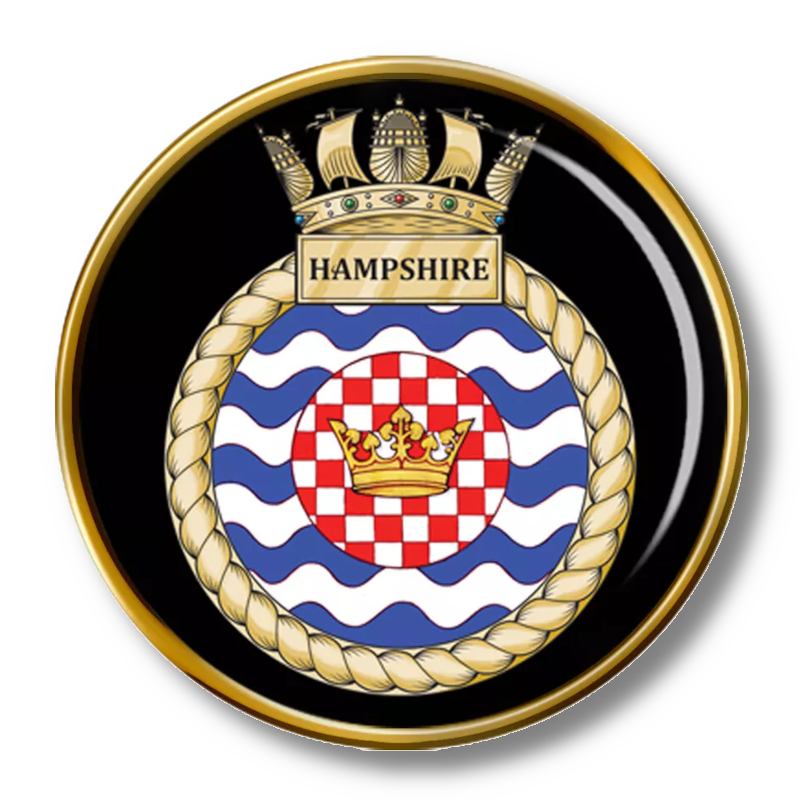
On 27 January 1914 he was posted to HMS Hampshire, an armoured cruiser of the Grand Fleet. This marked the beginning of his true war service. When the First World War broke out later that year the ship operated in the cold and dangerous waters of the North Sea, patrolling against German naval forces and enforcing the blockade. For stokers the war was fought unseen, labouring below decks to keep engines running and guns supplied with power, often sealed in their compartments during action.
In May 1916 HMS Hampshire took part in the Battle of Jutland, the largest naval engagement of the war. Only days later, on 5 June 1916, the ship sailed again from Scapa Flow carrying Lord Kitchener on a diplomatic mission to Russia. Shortly after leaving the Orkney Islands she struck a mine in heavy seas and sank with great loss of life.
Edward Thomas Hill was among those killed that day. His body was never recovered and he is commemorated on the Portsmouth Naval Memorial. His service, from eager recruit to fleet sailor, reflects the experience of many young men who left rural Hampshire for the unforgiving conditions of the North Sea and did not return.