5000 BC – Neolithic Hambledon
This section covers the years where we can claim there was human settlement in our village surroundings. There is no evidence of dwellings or man-made buildings before the Neolithic period of the Stone Age.
Ancient Hambledon: Neolithic Era: 5,000-2,500 BCE
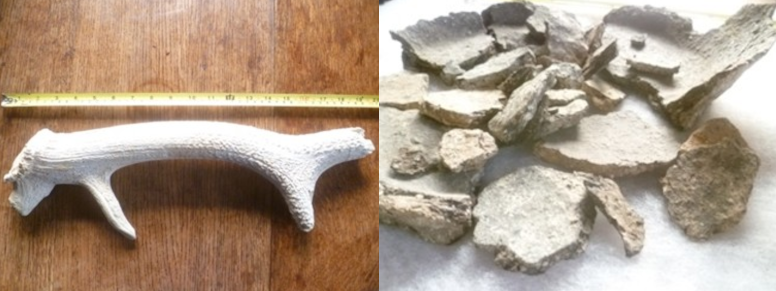
Although we have no direct archaeological evidence of settlement in the form of dwellings in Hambledon itself, the surrounding downland and farm fields have a lot of evidence of human activity in the form of flint arrowheads and other flint tools. A burial site was also discovered in the 1990s complete with an antler digging tool and this points toward settlement. We don’t have a record of the exact location though the finds were identified by Winchester Museum Services as grave goods and dated as around 750 BCE.
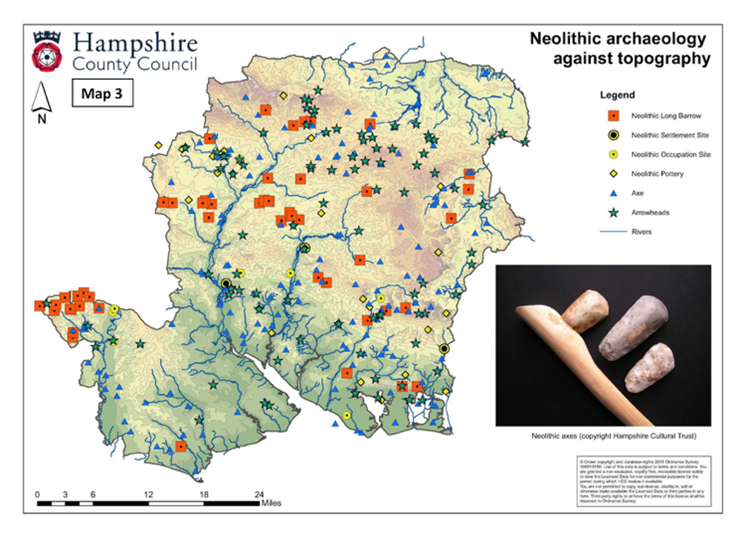
The Neolithic period brought fixed settlement and primitive farming and the use of simple stone tools and weapons that were used in hunting by wide-ranging foraging. The open downland country had more trees in that era and only beaten tracks for population movements – and those tracks took the most favourable terrain which would have been either the high ridges or the valleys. South Hampshire’s general topography is high ground running east-west and valleys running north south and the grain of the landscape leading to lines of travel was one factor in human settlement; another factor in the chalk downland was availability of water. Modern Hambledon sits roughly in the confluence of two dry valleys though the one running NE to SW may well have had an all year round stream flowing along it in the Neolithic period which in more modern times became a winterbourne. In any event the availability of water and the topography may have made Hambledon a settlement earlier than we know.
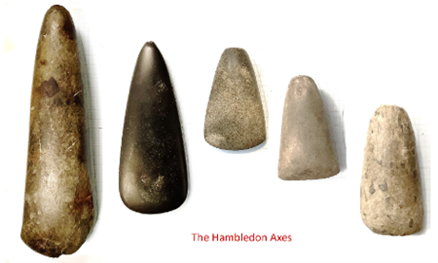
The Hambledon Axes
The discovery of a hoard of stone tools during the building of a new house in the 1980s poses unanswered questions. A pair of houses was constructed on the site of an old pond; clearly it was not of any great size or depth and digging the foundations turned up this collection of axes which is a unique trove in Hampshire. The axes are now under investigation by Southampton University’s Archaeology Department and Professor Josh Pollard gave an illustrated talk about them and aspects of Hambledon’s Neolithic legacy in our village hall in October 2024. Different theories are being explored: the varying origins of the stone from which the axes are made raises questions: was this, in olden days, actually a votive offering cast into a pond that rose and fell by the season, or were they planted in this location by an antiquarian collector in Georgian or Victorian times?
Whatever are the facts about the axes, other lithic finds like arrowheads are plentiful in the cultivated fields around the Parish, so early human activity in the area is undeniable but we don’t know for sure where these roaming Neolithic peoples were settled.
South Hampshire’s general topography is high ground running east-west and valleys running north south and the grain of the landscape leading to lines of travel was one factor in human settlement; another factor in the chalk downland was availability of water. Modern Hambledon sits roughly in the confluence of two dry valleys though the one running NE to SW may well have had an all year round stream flowing along it in the Neolithic period which in more modern times became a winterbourne. In any event the availability of water and the topography may have made Hambledon a settlement earlier than we know.
Hampshire County Council has created The Atlas of Hampshire Archaeology which maps ancient sites across the county and shows human geography in relation to topography and landscape type. Hambledon is located in an area that shows great prehistoric activity.
View the Atlas here: https://documents.hants.gov.uk/archaeology/TheAtlasofHampshiresArchaeology.pdf