43 – Roman Hambledon
The arrival of the Romans in 43AD is portrayed as a military invasion which is generally true because Rome certainly used military force – first in Julius Caesar’s attacks in 54BCE and then in Emperor Claudius’ sustained invasion in 43AD that set out to subdue the violent resistance of the inhabitants occupying the farthest reach of the Roman Empire. The blood that was shed in battle was the native Celt’s but also that of Rome’s multinational force drawn from the corners of its Empire.
Romans, however, had been trading with southern and western Britain before the invasion; Cornish tin, copper and gold were high on the list and that important commodity, salt which was produced locally in Hampshire but was also transported to the south coast from the bottomless mines of Cheshire. Roman trading vessels sailed in and out of the likes of Bosham and enduring trade agreements with local Celtic chieftains, possibly even resulted in Romans settling inland before the domination of the main invasion.
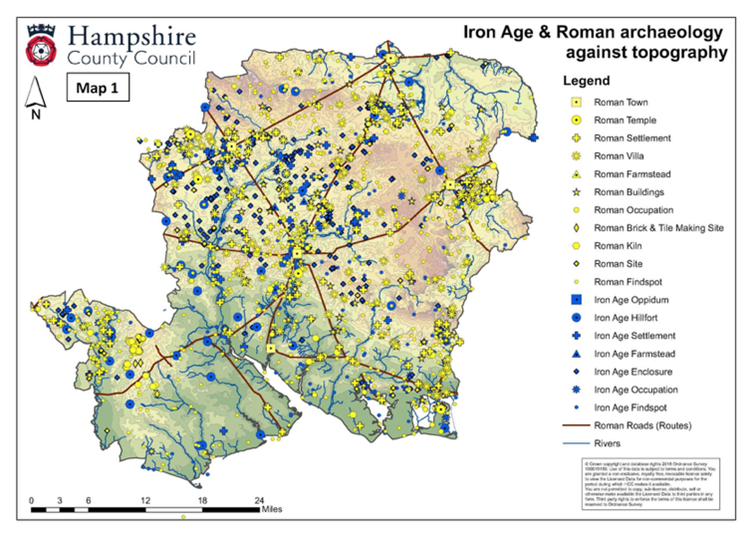
The map below imposes Roman infrastructure over Iron Age and shows how Roman settlement followed the pattern of the Iron Age but now the landscape is criss-crossed by the astonishing Roman road network which transformed the land by taking transport from its traditionally secure routes along the coast and rivers and, in unerring straight-line roads, connecting cities and towns.