956 – Saxon Hambledon
The waning of the Roman Empire in the 5thC was accompanied by the spread of Germanic tribes across Europe and into the islands of Britain. The peoples migrating to our isles in this period were Angles, Saxons and Jutes. The Jutes predominated in the area that is now Kent and they migrated further west to the Isle of Wight thence to the Meon Valley where they were called the Meonwara. We would love to know the point at which early Hambledon became a settlement, and which tribal group they came from – it seems likely they would have been Jutish but Saxons peopled the area of Sussex which would have been equally easy to migrate from.
956AD Hambledon is first mentioned as Hamelanduna in a grant of land in Chidden:
King Eadwig to Æthelgeard, his princeps; grant of 10 hides (mansae) at Chidden in Hambledon, Hants. Latin with English bounds, Winchester, Old Minster
The ‘hide’ is a relatively undefined piece of land from a size point of view but generally sufficient to support a peasant family household and often equivalent to 120 acres. So not only a unit of area but also a taxable unit. Aethelgeard added this gift to substantial lands he owned, mainly in the surroundings of Winchester but also much further afield.
This period, known widely as the Anglo Saxon, established a new language of Old English based on the Germanic tongue the tribes brought with them. They also brought pagan religion but were increasingly Christian from the 7thC. Christianity was not new to Britain, it came with the Romans from 4thC but the pagan Anglo-Saxon influence kept the faith to the Celtic areas until missionaries began their work in the late 6thC.
The increasingly ordered Anglo Saxon Britain was complex, with several kingdoms of which Wessex and Mercia carried most influence. Conflict between these fiefdoms was endemic and power shuffled between the kingdoms based on military might, so Mercia might be ascendant until Wessex became stronger. And in fact the threat of Viking raids in the 8thC were a factor in uniting the kingdoms in a joint English response under Wessex king, Alfred the Great. And his dynasty continued to rule England south of the Humber until the early 11thC.
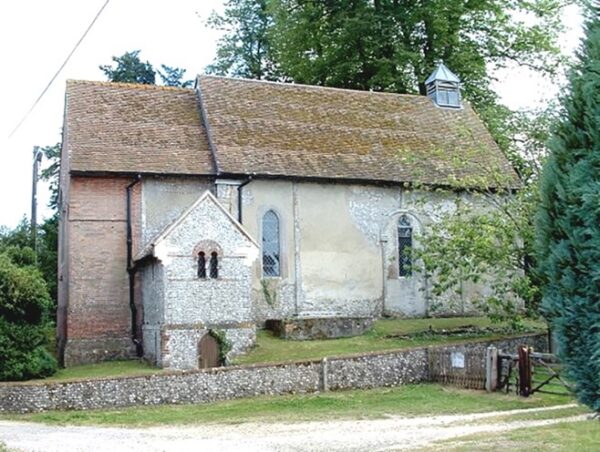
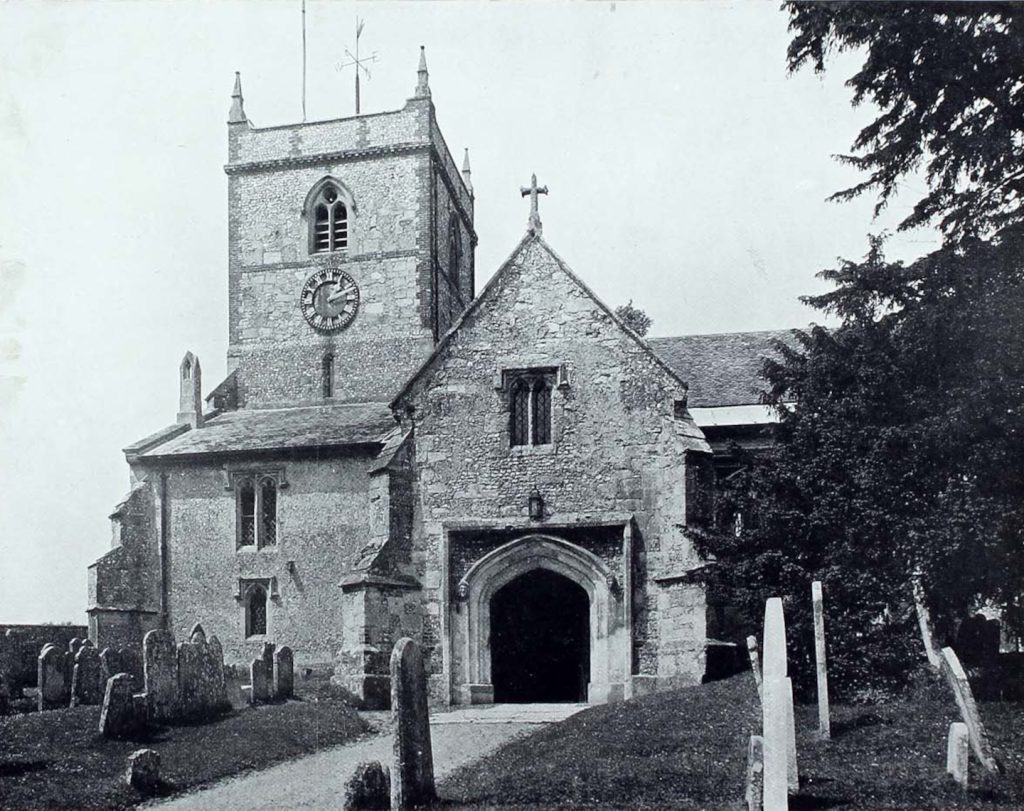
The most concrete relic of the Saxon era in Hambledon is embedded in the Church of St Peter & St Paul which started out in 11thC as a simple and small Saxon edifice and then was subsumed in later enlargements from the Norman era onwards. {see more about the Saxon legacy of our Parish Church here…} It is generally thought that the Saxon church of Corhampton nearby, built in 1020 might be a close match for Hambledon’s original church. Each edifice is remarkable in its own way. The cleric responsible for bringing the Christian gospel to Meon Valley, Wilfrith, created early places of worship using simple wattle and daub so any standing church in stone or flint construction may have had more primitive predecessors. Likewise, the location of early mediaeval churches is often thought to occupy sites with older spiritual and possibly pagan associations. Some Roman archaeology has been found near to Hambledon church and those remains must have been buried well before the Saxon church’s construction.